Saturday, February 17, 2018

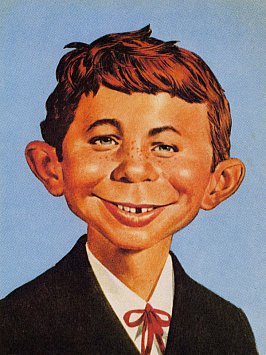
Whatever Happened to Alfred E. Neuman? We think we know...


Image result for alfred e neumanImage result for blase cupich


Although the U.S. FBI can't seem to find its own rear end with both hands, your intrepid blogger believes he has located the elusive Mr. Neuman, that 1960's icon of silliness. He is causing all sorts of chaos disguised as a Prince of the Church. Just look at these photos...I think the evidence is conclusive.

In case you still need further proof, just read this piece from Crisis Magazine, in which the invaluable Father George Rutler describes the latest antics of Cardinal Soupy as only Father Rutler can:

https://www.crisismagazine.com/2018/clarity-cardinal-cupich

I rest my case.  Pray, please, for the faithful of the Archdiocese of Chicago.  They survived Bernardin, so one supposes they also will survive Cupich.  But pray for them, anyway. 

Laudator Jesus Christus!


Wednesday, February 14, 2018

Ash Wednesday- To Dust Thou Shalt Return

Today is Ash Wednesday, the traditional opening of the holy Season of Lent. Since the early days of Christianity, the faithful have used this time to look inward, to take actions to better conform ourselves to Christ by prayer, fasting and almsgiving. We pay homage to the memory of Our Lord's sacrifice by making our own small personal sacrifices each day, in these three traditional ways and/or by adding other holy practices such as spiritual reading, silent contemplation, or donating our time to others.  
The imposition of ashes (which in the US is done normally on the forehead, but is done in other ways elsewhere in the world) serves to remind us, as we are admonished in Sacred Scripture, that "for dust thou art, and into dust thou shalt return." (Genesis 3:19). 
For Catholics in the US, today the Church directs us to abstain from meat and meat products (ages 14 and older, medical needs permitting) and to observe a partial fast (ages 18-59), meaning we may eat one full meal and two small meals which together do not exceed a full meal, with no snacking in between (again, medical needs permitting.)
It is worthy of note that our Orthodox brethren and many Eastern Catholic rites still observe a more traditional and stringent fast during Lent, abstaining from all meat (and in some cases all dairy products) for the entire forty days, with Sundays excluded or not, depending on local custom. I like to remember that whenever I start feeling sorry for myself as my tummy growls around 3 in the afternoon, awaiting the day's one full meal, which I normally take in the evening. 
[RETIRED LAWYER DISCLAIMER: Consult your physician before undertaking any food-related fast. God doesn't want you to endanger your health.]
The following is taken from today's traditional Divine Office (Matins, 1960 Rubrics), and is in my view a very good short reflection for this day. (Imagine that--the Church picked good material for reflection many centuries ago.  😁)
+++
Gospel reading- Matthew 6:16-21 (Douay-Rheims)
[16] And when you fast, be not as the hypocrites, sad. For they disfigure their faces, that they may appear unto men to fast. Amen I say to you, they have received their reward. [17] But thou, when thou fastest anoint thy head, and wash thy face; [18]That thou appear not to men to fast, but to thy Father who is in secret: and thy Father who seeth in secret, will repay thee. [19] Lay not up to yourselves treasures on earth: where the rust, and moth consume, and where thieves break through and steal. [20] But lay up to yourselves treasures in heaven: where neither the rust nor moth doth consume, and where thieves do not break through, nor steal. 
[21] For where thy treasure is, there is thy heart also. 
Homily by St. Augustine, Bishop of Hippo.
Bk. ii. on the Lord's Sermon on the Mounts ch. xii., torn. 4.
It is evident that by these precepts we are bidden to seek for inner gladness, lest, by running after that reward which is without, we should become conformed to the fashion of this world, and should so lose the promise of that blessing which is all the truer and more stable that it is inward, that blessing wherein God hath chosen us to be conformed to the likeness of His Son. In this chapter we will principally consider the fact that vain-glory findeth a ground for its exercise in struggling poverty as much as in worldly distinction and display; and this development is the most dangerous, because it entices under pretence of being the serving of God.

He that is characterised by unbridled indulgence in luxury or in dress, or any other display, is by these very things easily shown to be a follower of worldly vanities, and deceiveth no one by putting on an hypocritical mask of godliness. But those professors of Christianity, who turn all eyes on themselves by an eccentric show of grovelling and dirtiness, not suffered by necessity, but by their own choice, of them we must judge by their other works whether their conduct really proceedeth from the desire of mortification by giving up unnecessary comfort, or is only the mean of some ambition; the Lord biddeth us beware of wolves in sheep's clothing, but by their fruits, saith He, ye shall know them.

The test is when, by divers trials, such persons lose those things which under the cover of seeming unworldliness they have either gained or sought to gain. Then must it needs appear whether they be wolves in sheep's clothing, or indeed sheep in their own. But that hypocrites do the contrary maketh it no duty of a Christian to shine before the eyes of men with a display of needless luxury; the sheep need not to lay aside their own clothing because wolves sometimes falsely assume it.
+++

Laudator Jesus Christus 

Thursday, October 5, 2017

On The Filial Correction


It now has been over a week since an initial group of 62 Catholic scholars and clergy made public a 25-page plea to Pope Francis which they called a correctio filialis de haeresibus propagatis, or "filial correction of the propagation of heresies."  The basis of the correction is a series of passages from the Apostolic Exhortation Amoris Laetitia, ("AL"), together with "words, deeds, and omissions of Pope Francis which make it clear beyond reasonable doubt that he wishes Catholics to interpret these passages in a way that is, in fact, heretical."  
The document quotes in detail the passages from AL which are of concern and then describes meticulously the subsequent "words, deeds and omissions" of the Pope giving rise to the correction, as well as why the writers believe the correction is both justified and necessary.  In the ten days since its publication, the correctio has garnered additional signatures of scholars and clergy, now totaling more than 200, and supporting petitions circulated by two prominent Catholic websites (www.onepeterfive.com and www.lifesitenews.com) have garnered over 15,000 signatures, and counting.  I am not enterprising enough to insert links to all of my sources, but between the two websites just cited you ought to be able to verify all of the foregoing.

In the modern world of the Internet-based news cycle, a week is a long time, which clearly has proven true in this case.  The blogosphere, and not only the Catholic stations thereof, has been inundated with discussion which falls more neatly than one might expect into two broad categories.  On the one hand, the correctio has been welcomed and its provisions have been summarized or analyzed by Catholics who have for varying lengths of time expressed reservations (to put it mildly) about the Francis papacy in terms of its fidelity, or lack thereof, to the traditional teachings of the Church.  On the other hand, the self-proclaimed "progressive Catholic" media, as well as many who fancy themselves "conservatives" yet refuse to acknowledge there are any problems with the current papacy, have lashed out at the signers of the correctio without a single one of them, so far at least, engaging in even a minimal way with the substance of the issues raised.  I find this disappointing, yet not surprising, at least so far as the overt "progressives" are concerned, and in any event it is quite telling.  If you've read my "about me" page, you know that I am a retired lawyer, and there is a truism among lawyers who have actually tried cases: when you have no case on the facts, you have to attack the credibility of your opponent.  This is precisely what we are seeing right now.  The leftist/Modernist wing and the "nothing to see here, folks" so-called conservatives cannot engage the correctio on the facts because the facts are indisputable.  Go read the document for yourself, rather than relying on me or anyone else to tell you what it says.  If you aren't operating with a closed mind full of pre-conceived notions about how wonderful Francis the Merciful is, you will see the problems.  If you do happen to be one of those who blindly follows Francis and assumes that everything he says must be wonderful just because he occupies the See of Peter, then I pray you will read the document and open your mind and heart to the truth.  It's not pretty, but then, truth often is difficult to accept. 

As far as the signers of the correctio are concerned, rather than being attacked and belittled, these men and women deserve the sincere thanks of every person who seriously aspires to be a follower of Jesus Christ in the one Church he founded, which is the Catholic Church.  I believe these people have laid their names and in some cases their livelihoods on the line solely for love of the Church and the office of Peter.  They have done, in my view, an excellent job of explaining some of the most serious ways in which Francis/Bergoglio has essentially thumbed his nose at Christ and His Church for the past four-plus years, and it's about time (long past time, actually) that Catholics who love the faith as handed down from the Apostles, rather than the Modernist aberration to which we've been subjected for the past few decades, at least, stand up and be heard.  To me, silence in a matter such as this equates to acceptance of the status quo, and I am no longer willing to do that.  A faithful Catholic does not lightly use the word "heresy" but I am convinced that heresy is in fact being encouraged, at least, if not directly propagated, by this Pope and his minions.  Meanwhile, the so-called shepherds of the flock (that's you, bishops!) sit by silently, whether out of fear for their worldly positions or because they actually agree with what is happening, I cannot know. To me, these are the only two possible reasons for their silence, and in either case every bishop who fails to speak out is endangering his own soul and the souls of only God knows how many of his flock.  

Yes, I do believe it is that bad.  We are witnessing a crisis of a magnitude not seen since the Roman persecutions.  It's even worse than the Arian heresy, which after all involved only one issue, albeit a very important one, the Divinity of Christ.  But even so, during the Arian heresy, people living in an objective state of mortal sin were not being told it was perfectly OK for them to receive Holy Communion without repentance and a firm purpose of amendment, or that God might, because of the "complexity" of their "concrete situations", actually be directing them to engage in objectively sinful acts, or that "Jesus loves it when we sin", all of which are either contained in Amoris Laetitia or, in the case of the "Jesus loves it when we sin" remark, have been publicly stated by the current Pope.  

Please, read the correctio, and keep in mind that it only represents the tip of the iceberg in terms of the things this Pope has said and done which conflict with perennial Church teachings.  If you want more and are willing to do a little work to get it, check out this website, which chronicles no less than 166 such instances: https://en-denzingerbergoglio.com/

The correctio is a serious effort by serious people to call attention to what they, and many others, believe is a disastrous situation in the Church.  Yet the authors have done what they perceive to be their Christian duty with clarity and charity--the latter being a quality conspicuous by its absence from the chorus of calumny being directed at them by those who prefer to obscure or ignore the truth.  

Our Lady of Fatima, pray for us.

Laudator Jesus Christus!

Tuesday, August 29, 2017

On "Fitness" For Elected Office

This is not a political blog, nor do I wish to make it one. But I am greatly irritated by a recurring theme of commentary by putative intellectuals in the political blogosphere over the past nine months or so.  If you just said to yourself, "Hey, that's about how long it's been since the U.S. Presidential election," and if you're guessing my irritation has to do with commentary about President Donald J. Trump, give yourself a gold star.

I am not here to defend or praise Donald Trump as a man or as President. I certainly have my own opinions about him and his actions and stated agenda, but those opinions are not the basis of my irritation. What galls me is the constant drumbeat of the pundit class to the effect that Mr. Trump is "unfit" for the office he holds. That this drumbeat comes from both sides of the standard political fence in the US matters not one iota. For the record, I was just as irritated when I heard or read claims that Barack Obama was unfit or unqualified to be President.  He got elected, just like Trump, and that was all I needed to know.  I didn't have to like it.  The astute reader will see where this is going.

Keep in mind, it is a historically proven fact that the Left will hate and excoriate anyone who disagrees with them, even if he or she were a canonized Saint; in fact, perhaps especially if he or she were a canonized Saint, since the Left generally disdains anything resembling traditional faith and anyone who professes it.  The Right is perhaps less inclined in general to engage in ad hominem attacks on its ideological opponents, but in the present case there is a cadre of self-proclaimed "Never Trumpers" in the conservative/neocon ranks who seem to have forgotten whatever they once may have known about civility and collegiality and respect for others.  Right now, they all are acting like five-year-olds whose tricycles have been taken away.  I wish with all my heart that everyone sitting in front of cameras or keyboards who is beating this drum about Trump's "unfitness" would simply stop. Shut up. Put a sock in it. ENOUGH, ALREADY!

To this complaining chorus of pundits, I answer that:

First, it doesn't matter one bit whether you, in your proclaimed wisdom, think Donald Trump is fit to be President.  He meets the Constitutional requirements for the office. His name was legally on the ballot in every state and the District of Columbia, and he won the election in the manner prescribed in the Constitution and laws of the United States of America. Therefore, by definition, he is "fit" to be President of the United States, just as all of his predecessors were.  Whatever may be your personal judgment of him, his past, his personality, his proclivities, his social media habits, his actions in office, or anything else, is completely irrelevant to this fact.

Second, if you're so all-knowing about what the qualities of a President should be, and since you obviously think you're so much smarter and more sophisticated than the umpty-ump million people who voted for the guy, why didn't you run and get elected yourself, or get someone else elected who meets your lofty standards?  Until you do that, please be courteous enough to spare the rest of us your whining. Criticize the policies, argue about the appointments, the social media posts, whatever.  But shut the heck up about "unfitness for office."  You lost that argument last November.

There, I feel better now.  My career as a political blogger is over.

Laudator Jesus Christus!

Saturday, August 26, 2017

On Liturgical Reform and Papal Authority

So, as he has a habit of doing, Pope Francis has set off a blogosphere fireworks display with a speech he made this past week to a conference of Italian liturgists.  As an aside, I note for the record the suggestion by one prominent Catholic blogger, who has spent a good deal of time in Italy, that his "mind reels in dread at the very notion of a room full of Italian liturgists." :)

Cutting to the heart of the matter, in the course of a typically verbose oration, the Pope declared that "we can affirm with surety and with magisterial authority that the reform of the liturgy is irreversible."   He thus used words traditionally associated with dogmatic statements of faith and morals, although he was speaking about liturgical rubrics, which are, by definition, disciplinary in nature, not dogmatic.

For those who may not know, "discipline" and "dogma" (or "doctrine, if you prefer) are terms of art in the Catholic Church. Disciplines are rules made by men, not matters of Divine revelation, and thus are subject to change. Conversely, dogma is grounded in Divine revelation and, by definition, cannot be changed. Why is this? Because God's law, like God, is eternal and immutable.  A good example of a Church discipline is the set of rules surrounding abstinence from eating meat during Lent, which has been modified numerous times over the centuries, while the mystery of the Holy Trinity, i.e., that we worship one God in three divine Persons, is a good example of a dogma.  It has not been, and cannot be, changed in any way since its revelation to humanity through Jesus Christ, although our understanding of the mystery of the Trinity has developed over time, and likely will continue to do so.  Contrary to some Modernist views, it is not possible for "development of doctrine" to effect a change in the essence of the doctrine.  Rather, development can only broaden and deepen our understanding of that essence.  Take a look at Blessed John Henry Newman's famous essay on the subject for more about doctrinal development.

Let us turn back, then, to the Pope's assertion "with magisterial authority" that "liturgical reform," in this case the replacement of the Tridentine Mass with the Missal of Paul VI, commonly referred to as the "Novus Ordo" Mass, is "irreversible."  As has so often been the case since the beginning of this pontificate, a flood of attempted explanations of this assertion has swept over the online Catholic world, with the usual division between those who attempt to justify it and those who criticize it.  For my money, Father Z's review (linked above) is the most satisfactory, although the commentaries by canon law expert Edward Peters and blogger Phil Lawler are also good.  Mr. Peters, as usual, analyzes the issue in great detail and with a canonist's eye.  Lawler comments from the perspective of an intelligent layman.  Both see, as I do, significant confusion arising from the attempt to apply "magisterial authority" to a discipline, rather than a doctrine.  I will simplify: It just doesn't work. Magisterial authority, in the sense of infallibility, is not applicable to discipline, only to doctrine. Period.

The "irreversible" label is further belied by the history of the Liturgy itself.  It has never been static, and with the sole exception of the huge changes imposed by Paul VI, has developed slowly, organically if you will, over the nearly two thousand-year history of the Church.  The change to the Paul VI Missal was, I am told by many who lived through it, wrenching and disorienting to say the least, and resulted in many, perhaps millions, leaving the Church entirely; this obviously was not the intended result, but it is a fact, and remains a major source of internal disagreement in the Church to this day.  It also was a matter of discipline rather than doctrine, fully within the authority of the Holy See, but by no means permanent, whatever the wishes of the Modernist/Progressive faction might be. I have no doubt that Francis, who has never been shy about his general disdain for people who prefer the traditional Mass, had them and the TLM in mind in saying what he said.  But the point is, no discipline of the Church is irreversible.  If that were the case, then Paul VI would have lacked the authority to impose the Novus Ordo over against the statements of Pope St. Pius V in his implementation of the Tridentine Mass, in the encyclical Quo Primum of July, 1570.  For more detailed analysis of this issue, go here.

Thus, as I see it, many commenters have missed the boat on this one.  The "progressives" who are chortling about Francis putting the "Trads" in their place by whacking them with his "magisterial authority" are wrong, because magisterial authority has no application to liturgical norms.  But so are the Trads wrong, who claim that not only is Francis unable to render the "liturgical reform" irreversible, but also that Paul VI himself had no authority to enact the Novus Ordo Mass in the first place.  Any Pope or Council has the authority to change Church discipline, and that includes liturgical norms.  It's not the infallible Magisterium at work, so it can even be a mistake to do so, but it's licit and valid.  That's the nature of things.  So my advice is, take a deep breath, pray a Rosary, go to Mass (TLM or N.O., your choice), and chill.  The Apocalypse hasn't arrived just yet.

Laudator Jesus Christus!

Monday, August 21, 2017

Questions For Catholics (Fun Post!)


Here's a non-serious post, for a change. Courtesy of Julie over at Connecticut Catholic Corner (see Blog Roll)...here are 34 fun questions to answer.  Post your answers as a comment on this blog and also on Julie's so we can see your answers.  Here are my answers:

1.  Latin
2.  Convert (2005)
3. 1954 (Presbyterian, in a church co-founded by my great-grandfather)
4.  2005, Easter Vigil
5.  St. Thomas Aquinas
6.  Blessed Virgin Mary!
7.  Ordinary (But I wish it were otherwise--long story)
8.  St. Joseph
9.  RCIA team, KofC
10.  The Rosary
11.  The Rosary, Matins (1960 Divine Office) (I'm retired so I have LOTS of time!)
12.  A Rosary
13.  Lent  (Yes, really.  Forced spiritual growth!)
14.  Other than Easter...Our Lady of Fatima
15.  Holy Communion!
16.  Yes
17.  Nine days ago
18.  Marriage
19.  O Salutaris Hostia
20.


21.  The Passion of the Christ
22.  The Hail, Mary song they play after the Rosary on EWTN
23.  Pascendi Domenici Gregis (St. Pius X on Modernism)
24.  Deep blue (almost purple)
25.  Ave Maria (J.S. Bach)
26.  John 12:24 (The verse that triggered my conversion to the Catholic Church! Long story...maybe I'll blog on it someday.)
27.  The Gospel of St. John.  Or the Confessions of St. Augustine, if Scripture doesn't count.
28.  Frequent confession? :)
29.  St. Pius X.  Would that all Catholics would learn from him about the Synthesis of All Heresies...and take his Oath Against Modernism!  Benedict XVI is second, since he became Pope one week after I entered the Church, and I was already hugely influenced by his writing, but I'm still so disappointed in his abdication.  One day I hope we learn the full story, as what we've heard so far just doesn't make sense to me.
30.  Oh, there are a lot of them...I won't be a smart aleck and name one of the Apostles, since they ALL were converts...I guess the most helpful one has been Dr. Scott Hahn, although Steve Ray, Father George Rutler and Blessed Cardinal Newman also deserve mention.
31.  Mother Angelica
32.  Carmelites
33.  Catholics who act like they'd rather be Protestants.  Just go, then!  There are at least 20,000 "denominations" you can choose from...
34.  The Sacraments!  Amen!

Laudator Jesus Christus!


On Our Behavior At Mass

There is an old Catholic maxim that provides the basis of today's reflection, "Lex orandi, lex credendi."   The Latin means, literally, "the law of prayer is the law of belief."  More colloquially, it often is recited as "we believe as we pray", or perhaps "as we pray, so we believe."  You get the picture.  The maxim expresses a truth observed by fathers and doctors of the Church throughout her nearly two thousand years of existence.  It bears frequent repetition and contemplation.

Liturgy, which includes both the Holy Sacrifice of the Mass and the Divine Office (a/k/a Liturgy of the Hours), is the public prayer of the Church.  As such, the manner in which we comport ourselves at Mass and while praying the Office (the latter being optional for the laity, but highly recommended!) not only reflects, but forms, the core of our beliefs as Christians.  This is one of the more important reasons why the Church specifies rubrics, or rules, for the Liturgy.

Logically, it follows that the more reverent and focused we are at Mass on the Word of the Lord and the holy Eucharistic sacrifice, the stronger our faith will become in all that the Word and the Eucharist are and represent.  The Word is, after all, God speaking directly to us through the instrument of the authors He inspired, and the Eucharist is the Body, Blood, Soul and Divinity of Our Lord Jesus Christ, given to us by God's boundless grace for our eternal redemption, and offered back to the Father by the whole Church in thanksgiving for this indescribably awesome gift.  Since God does not need this offering, he accepts our prayers and remains on the altar, to be received and consumed by us, the faithful members of Christ's mystical body on Earth, as a channel of sanctifying grace, after which we are sent back into the world to carry Christ and his Gospel to all.

This is the essence of the Mass, which we accompany with prayers, chants (preferably) or songs, and with meaningful gestures, all according to the rubrics--standing, kneeling or sitting at appropriate times for appropriate reasons.  As the priest or bishop leads the faithful in prayer, all should be participating not only externally but internally as well, praying from the heart all of the words of our audible responses as well as silently praying with the priest as he consecrates the Holy Eucharist.  As stated in the General Instruction of the Roman Missal: (a/k/a "G.I.R.M., or the "rulebook" for the liturgy):


17. It is, therefore, of the greatest importance that the celebration of the Mass or the Lord’s Supper be so ordered that the sacred ministers and the faithful taking part in it, according to the state proper to each, may draw from it more abundantly[26] those fruits, to obtain which, Christ the Lord instituted the Eucharistic Sacrifice of his Body and Blood and entrusted it as the memorial of his Passion and Resurrection to the Church, his beloved Bride.[27]
18. This will fittingly come about if, with due regard for the nature and other circumstances of each liturgical assembly, the entire celebration is arranged in such a way that it leads to a conscious, active, and full participation of the faithful, namely in body and in mind, a participation fervent with faith, hope, and charity, of the sort which is desired by the Church and which is required by the very nature of the celebration and to which the Christian people have a right and duty in virtue of their Baptism.[28]
[26] Cf. Second Ecumenical Council of the Vatican, Constitution on the Sacred Liturgy, Sacrosanctum Concilium, nos. 14, 19, 26, 28, 30.
[27]Cf. Second Ecumenical Council of the Vatican, Constitution on the Sacred Liturgy, Sacrosanctum Concilium, no. 47.
[28]Cf. Second Ecumenical Council of the Vatican, Constitution on the Sacred Liturgy, Sacrosanctum Concilium, no. 14.

Now, a question: how many Catholics in the pews at any given U.S. parish understand any, much less all, of the foregoing?  More importantly, how many act accordingly when they attend Mass?  If you answered "hardly any", you're probably right.  And that's sad.

A fellow blogger recently commented on this general topic, expressing her frustration and mystification with the way so many Catholics in the U.S. engage in extraneous gestures at Mass, such as raising hands in the priestly orans position, and/or holding hands (like Protestants!) during the Our Father, neither of which is prescribed by the faithful by the G.I.R.M.  Here is a short excerpt from her post:

I know why I used to lift my hands in the air when I was a Protestant during services. It is a verse from the New Testament (there are several other verses as well, some in the Old Testament) and encouraged by the ministers to join them in raising our hands (the only 'priesthood' is among all the believers). This was done to show the congregation was the same as the minister- mere believers. Ministers were nothing special.
1 Timothy 2:8 "I will therefore that men pray in every place, lifting up pure hands, without anger and contention."
But that isn't how a Catholic Mass works...or so I thought when I first became Catholic a decade ago. The missal said "stand" and I stood, the missal said "sit" and I sat, the missal said "kneel" and I knelt. The missal never said "hold hands" or "raise your hands in the air" etc., so I didn't, but others do. I don't get that. 
Read the rest of her post here.

I think Julie makes a great point.  And it's not confined to raising hands or holding hands during the Our Father.  Look around you the next time you go to Mass on Sunday, and ask yourself these questions:

1.  Before Mass, are people kneeling in prayer as they prepare to hear the Word of God and witness the miracle of the consecration of the Holy Eucharist?  Or are they glad-handing and chattering as if they're attending a happy hour or a birthday party?  I'll bet the latter greatly outnumber the former.

2.  Are you and your fellow parishioners dressed as if you're preparing to meet the God who created the universe out of nothing?  Or like you're going to a ballgame or to the beach?  In my regular parish in the Great State of Texas, where summer lasts for the better part of the year, it's mostly the latter. Shorts, tank tops or t-shirts, jeans, and flip flops are everywhere.  (I sometimes want to ask these people if they would dress that way for a personal meeting with the Governor or the President?  And if so, why would they not show at least as much respect for Jesus in the Eucharist as to an elected politician?)  The more "formally" dressed are likely wearing something appropriate for the golf course or "casual day" at the office.  I confess falling into this category myself, since while I never wear shorts to Sunday Mass, I rarely even take the trouble to wear a sport coat and dress slacks, much less a suit and tie, which would be most appropriate to the occasion.  Mea culpa!

3.  Are you one of the unfortunates whose parish forces a completely artificial "let's all greet our neighbor" ritual into the beginning of the Mass?  The "Liturgy of the Greeting" that doesn't appear anywhere in the G.I.R.M. or Missal?  If so, you have my sympathy.  You should be getting ready to meet Christ in the Eucharist, instead.  But I'm repeating myself.

4.  After Mass starts, how many are really paying attention to the readings, vs. looking at their smartphones, or gazing around at just about anything except the lector or the deacon or priest? Again, the latter probably outnumber the former.

5.  Back to Julie's comments quoted above--I'll almost guarantee you that most of the people are at least reciting the Our Father in the orans position, if not holding hands Protestant-style with total strangers. Amiright?  Eeeuw.

6.  Now comes my least favorite part of the Mass, the "sign of peace."  Is it barely controlled chaos, not to mention a great way to spread cold and flu germs throughout the congregation?  And if you have the temerity to refuse to shake hands with everyone around you, get ready for the hurt or even angry expressions on the faces of your pew neighbors, or even to be poked and prodded by someone who wants to insist that you hold hands with them.  Sheesh.  The more reverent parishes omit this optional exercise, and I wish mine would.  Notice, you'll never see it done during the televised EWTN Mass celebrated at their chapel in Irondale, AL or at the Shrine in Hanceville.  Never.

7.  Aaaand....Holy Communion.  Does your congregation unanimously shuffle down the aisle toward the priest or "Extraordinary Minister of Holy Communion" as if walking up to the counter at Burger King, without even so much as a reverent bow of the head? Does anyone make a profound bow, or even maybe genuflect, before receiving the Blessed Sacrament?  Very rare in most places, I would guess.  The real question here, I think, is: how many folks act as if they are about to hold in their hands or receive on their tongue the Body, Blood, Soul and Divinity of Jesus Christ?  Do not most people treat the whole thing as nothing more than a symbol, a cultural exercise devoid of faith in the Real Presence?  In other words, aren't most people acting like they don't really believe what the Church teaches about the Holy Eucharist?  And do you ever wonder how many of those people heading down the aisle to receive the Eucharist have darkened the door of a confessional at any time in the recent past?  Or even the not-so-recent past?  Amazing how many people never commit a serious sin, isn't it?  :)

All of the foregoing behaviors (excepting, I think, the ones in paragraph 7) might seem more or less innocuous by themselves, but added together they spell a significant lack of reverence for, and likely tenuous belief in, the truths of the Mass, and therefore the key truths of the Faith itself.  And these are the behaviors of people who actually attend Mass!  To paraphrase the Holy Apostle Paul, how much more lack of faith must there be in those who don't even bother to show up on Sundays?

Here's the thing: we didn't arrive at this state of affairs quickly.  We are witnessing the cumulative effects of decades of neglect of proper instruction, both in homes of the faithful and in the parishes and dioceses.  We are stuck with a whole generation or two, at least, of priests and bishops who were formed under Modernist seminary faculty, as a result of which they themselves often do not fully believe all that the Church teaches.  Even if they do believe, so long as the money keeps rolling into the parish and diocesan coffers, they see no reason to "rock the boat" by admonishing the faithful as to proper behavior in the celebration of Holy Mass.  The Novus Ordo liturgy itself also must share a large chunk of the blame, having stripped so many pious prayers from the Mass while it shifted the focus of the liturgy from Christ on the altar to the priest and other "ministers" milling around the sanctuary--a liturgy centered on Man instead of God.

One way to find more reverence at Mass it to attend a TLM parish, but most of us don't have that as a realistic option, at least not yet.  Otherwise, there's not much any of us can do by ourselves, except resolve to provide a good example to our fellow parishioners, and spend time in prayer and adoration asking the Lord to help move the hearts and minds of all toward a more reverent and respectful attitude, in word, gesture and deed.  And I suppose I should spend less time worrying about how other people behave and do a better job myself of imitating Christ.  That's a full-time job for anyone.  But it still makes my heart ache to see so many people essentially disrespecting Our Lord in his own house.

Laudator Jesus Christus!


Monday, January 23, 2017

On Mission Statements

I am now retired, but I spent over 30 years working in a large US corporation.  In the course of my career, my company went through all of the corporate management fads that swept American businesses, one of which was the infatuation with "mission statements" that began not too long after I came on board in 1983.  This is not the forum in which to discuss the pros and cons of the mission statement culture; like most corporate fads, it has its good and (mostly) bad points, and is only as effective as the people who use it.  I only bring it up because...believe it or not, my parish has a "Mission Statement." I won't repeat it here, but it's somewhat verbose, running fifty-five words, and is stated as the "mission" of "we, the members of St. XYZ parish."  That seems a bit exaggerated, since like most "modern" parishes, all the work not done by the priests and deacons and paid staff is done by about five or six percent of the registered parishioners.  Another fifteen to twenty percent actually show up for Mass at least once a week, and the rest are phantoms except possibly at Christmas or Easter, when they roll in with their guilt offerings (much appreciated, but where were you the rest of the year?) and clog up the church and the parking lot for the rest of us.  :)  In any event, the idea of "we, the members" issuing the mission statement is, in my view, just silly, and is one of the regrettable results of the attempt by the Second Vatican Council to de-emphasize the Church hierarchy.  As far as I can tell from studying the history of the past fifty years, (admittedly just the blink of an eye in the overall 2,000-year history of the Church), we likely would have been a lot better off if they had left the hierarchy alone and concentrated more on evangelizing and saving souls than on trying to make lay people feel more important.  Which leads me back to my real point.

The notion that a Catholic parish needs a spiffy "mission statement" at all simply bewilders me.  This is not a business.  It is not a public service organization, despite all the charitable and community works we do--those are some results of what we do, not the essence.  Every parish is simply a place where we gather to worship the God of the universe and to thank him for sending his Son to die for us, that we might have the chance to spend eternity with him in Heaven, and where we can receive the Sacraments established by Christ as channels of sanctifying grace to help us along the way.  So the "mission statement" ought to be very simple: "To bring souls to Jesus Christ and thus to eternal salvation."  There you have it, in eleven words that probably could be shortened even more.  Anything else is redundant.

Laudator Jesus Christus!

Sunday, January 22, 2017

Different Gospels

In Matins for today, January 22, we begin a sampling of readings from St. Paul's letter to the Galatians. Readers are undoubtedly familiar with the often surprising way in which Sacred Scripture presents messages relevant to the events and concerns of our time and our individual lives, and today's reading was a great example.  Here is an excerpt, emphasizing the verse that particularly caught my attention:
(Galatians 1:8) But though we, or an angel from heaven, preach a gospel to you besides that which we have preached to you, let him be anathema.
9 As we said before, so now I say again: If any one preach to you a gospel, besides that which you have received, let him be anathema.
10 For do I now persuade men, or God? Or do I seek to please men? If I yet pleased men, I should not be the servant of Christ.
11 For I give you to understand, brethren, that the gospel which was preached by me is not according to man.
12 For neither did I receive it of man, nor did I learn it; but by the revelation of Jesus Christ.
(Emphasis added.)

In your correspondent's opinion (which I hope is humble), these verses ought right now to be a subject of deep reflection on the part of certain Bishops and Cardinals of the Church.  I mean those who are telling the faithful that "pastoral accompaniment" and "discernment" allow for practices involving the Sacrament of Reconciliation and the Holy Eucharist which are quite clearly contrary to the bimillenial praxis and teachings of the Church. For the most glaring example thus far, go here. Not incidentally, these practices are just as clearly contrary to the words of our Lord Jesus Christ himself--which, come to think of it, might just be why the Church teaching has been what it has been for almost 2,000 years.  (Sarcasm off.)  One of several examples from the Gospels follows (emphasis added):

(Mark 10)

2 And the Pharisees coming to him, asked him: Is it lawful for a man to put away his wife? tempting him.
3 But he answering, saith to them: What did Moses command you?
4 They said: Moses permitted to write a bill of divorce, and to put her away.
5 Jesus answering, said to them: Because of the hardness of your heart, he wrote you that precept.
6 But from the beginning of the creation, God made them male and female.
7 For this cause a man shall leave his father and mother, and shall cleave to his wife.
8 And they two shall be in one flesh. Therefore now they are not two, but one flesh.
9 What therefore God hath joined together, let not man put asunder.
10 And in the house again his disciples asked him concerning the same thing.
11 And he saith to them: Whosoever shall put away his wife, and marry another, committeth adultery against her.
12 And if the wife shall put away her husband, and be married to another, she committeth adultery.
Similar words can be found in Matthew 5, Matthew 19, and Luke 16; see also 1 Corinthians 7:10.

Now, your correspondent is just an ordinary layman, trying to live according to the Lord's Commandments and example, and probably not doing a great job of it.  So I don't presume to know what could be in the hearts and minds of prelates and shepherds of the Church who are creating what looks an awful lot like a de facto schism by telling other ordinary laypeople that what the Church has strictly prohibited for almost 2,000 years is suddenly now OK.  I'm no historian and certainly no theologian, but I'm also not an idiot, and I know a logical contradiction when I see one.  It cannot possibly be OK in one diocese but a serious sin in the next one for a person living in a second "marriage", without having had the first marriage declared invalid, to be admitted to confession and holy communion with no intent to cease marital relations with the second "spouse." Yet, that is exactly the situation we now see before us, in the Holy Roman Catholic Church, the one founded by Jesus Christ, who is the way, the truth and the life.  One of the two cases is seriously wrong, and while I'm also not a betting man, I would put pretty much all I own on the 2,000 year old practice, which matches the words of Sacred Scripture, being the right one.  Again, I do not and cannot know what is in the hearts and minds of the bishops and cardinals who are promoting the other practice, but it seems to me, based on their words and actions, to be one designed to please men, not God.  Whereas, St. Paul wrote..."If I yet pleased men, I should not be the servant of Christ."

Please pray and fast and offer sacrifices for the Pope and all the Bishops and all of our priests.  This is a matter affecting the eternal salvation of souls, starting with theirs. "And unto whomsoever much is given, of him much shall be required...". Luke 12:48b.

Laudator Jesus Christus!


Thursday, September 8, 2016

Does Anybody Really Know What Day It Is?


Today, September 8, is the date on which the Roman Catholic Church has, since approximately the Sixth Century, (in other words, for no more than about 1500 years) celebrated the birth of Our Lady, the Mother of our Lord Jesus Christ, the Blessed Virgin Mary.  While it is far from the most solemn Marian feast day on the Church calendar, it's still a big one, because it's her birthday (or at least, the day we've chosen to celebrate it, because we don't really know exactly what day she was born.)  We love and honor Mary because Jesus gave her to us as our spiritual Mother as he hung in agony on the Cross, and because ever since that dark day her sole occupation has been to lead each and every one of us closer to her divine Son, all glory and honor to him forever and ever, Amen!  This, not to mention that as any good Catholic knows, we are pretty sure Jesus loves his Mother a lot, and that it makes him happy when we love her, too. 

Now, the U.S. Conference of Catholic Bishops (USCCB) has a nice email service that sends out the Scripture readings for each day's celebration of the Mass, very early in the morning.  They also have a general communications email service.  Anyone can subscribe to both of them at no cost by going to the USCCB website. I get the daily Mass readings and also subscribe to the general email blasts because every now and then they actually send out something really interesting or helpful.  So on the day the Church celebrates the birthday of Mary, our Blessed Mother, does the USCCB mention this, and perhaps suggest ways in which we might honor her in prayer, and ask her to intercede with her Son for us, and for others in need?  No.  In fact, there is no mention whatsoever of today's feast.

Instead, we get this:
"In light of recent incidents of violence and racial tension in communities across the United States, the president of the U.S. Conference of Catholic Bishops (USCCB) has invited faith communities across the country to unite in a Day of Prayer for Peace in Our Communities on September 9th.

To assist in observance of this occasion, USCCB is offering a Prayer for Peace in Our Communities prayer card."
How nice.  But not one word about the Nativity of the Blessed Virgin.  That was the best that the U.S. Conference of Catholic Bishops could do today?

Now, don't get me wrong...I'm as big a booster as you'll find anywhere of prayer as our number one tool against everything bad in the world and in support of everything good, in this world and the next.  All prayer is good, and when groups of people get together to pray for the same things, it's even better.  It's especially handy for the salvation of souls through the redeeming grace of our Lord.  (You know, that's sort of why we think it's important to go to Mass at least once a week!)


But to the USCCB communications team I have to say: You, of all people, should be aware that in the entire liturgical year, the Church only celebrates the nativity of three people--Jesus, Mary, and St. John the Baptist.  Every other saint is honored either on the date of their death (i.e., their birth into eternal life), or some other important date, such as being ordained a bishop or being elected Pope. That would tend to suggest that, well, maybe the Church thinks those three people are kind of important, you know?  Nevertheless, your email blast completely ignored today's celebration of Mary's nativity. 

This is just poor judgment, at best.  The bishops are supposed to be the shepherds of the CATHOLIC Church in the USA, the Church that still gives the Virgin Mary the honor she deserves, when very nearly all others who profess the name of Christ have thrown her overboard except for a couple of weeks around Christmas each year.  But instead of making even the merest mention of today's celebration, a very Catholic day, the USCCB PR machine sends out a release that could have come from any Protestant.

Now, here's the other kicker, another complete swing and miss that really makes me wonder if anyone at the USCCB communications office ever looks at a Church calendar.  Did you perhaps wonder why the bishops chose tomorrow, September 9, as the day to call "faith communities" to prayer to end racial tension?  I have an idea: September 9 is the feast day of another Catholic Saint, St. Peter Claver.  Ever hear of him?  He was a 16th Century Spanish Jesuit priest, whose missionary work in South America was primarily dedicated to the corporal and spiritual needs of the thousands of Africans who were transported into Cartagena, Colombia to feed the slave trade in the New World.  He is now revered as the patron saint of slaves and African-Americans, so his feast day is a perfect time for this prayer effort. But the email communique' from the USCCB managed to miss that, too! Not a word about St. Peter Claver! 

Next year, my suggestion for the USCCB is:  By all means, have another call to ecumenical prayer for the end of racial tension in the US on September 9, the feast day of St. Peter Claver.   But try to remember to mention him in your announcement, and send it out a few days in advance.  Then, on September 8 you can send out a reminder for all us to celebrate the Nativity of the Blessed Virgin Mary.  See how easy that is?

Good thing the bishops have me around to straighten them out, right?  :)

Laudator Jesus Christus! 


Thursday, September 1, 2016

Re-Posting: The Coming Tribulation?

This was originally posted in November, 2015.  Now seems like a good time to review these observations.  One introductory paragraph has been deleted since it no longer applies.  The rest is copied mostly verbatim.
___________________

“I expect to die in bed, my successor will die in prison and his successor will die a martyr in the public square. His successor will pick up the shards of a ruined society and slowly help rebuild civilization, as the church has done so often in human history.”

Francis Cardinal George, former Archbishop of Chicago (d. 2015)

I continue to be intrigued by one thread that seems to be running through many of the blog posts and comments I've been seeing: the idea that the Church is facing a crisis unlike any other in its history, and that the resemblance of the present situation to apocalyptic prophecies in 20th Century private revelations, especially Our Lady's appearances at Fatima and Akita, is strong enough to warrant the most serious concern.  The End is near!  Fear, fire, foes! Awake! (Apologies to J.R.R. Tolkien.)

Well, OK then.  It does seem clear to many (most?) of an orthodox mindset that the Church is indeed in a state of crisis, and I have a hard time disagreeing with such an assessment. See my August 10 (2015) post, for example.  To run through another brief summary of the "bad stuff":  In recent times we have witnessed the violent slaughter of many thousands of Christians (mostly Catholics and Orthodox) in the very birthplace of the Faith, together with wanton destruction of their churches and holy treasures, by barbaric Jihadists bent on eradication of everything and everyone that is not Muslim; the near total collapse of European Christendom; a seeming rush of North and South America to follow suit via declining Mass attendance, millions of annual defections to "evangelical" or "none" status, the enshrinement in secular law of false marriages and the concomitant state and media persecution of Catholics and Catholic institutions who refuse to affirm them; and a papacy that praises material heretics (e.g. certain German Cardinals) while excoriating as "pharisees" those who stand for traditional doctrine and practice, and which sometimes seems more concerned with pleasing the international secular media than with the salvation of souls and the preservation of the deposit of faith.  To be fair, at other times we hear strikingly orthodox statements and exhortations of the type to which we have grown accustomed over the past several pontificates.  (Confused?  So am I.)

Even so, however, is it really as bad as some maintain?  Stated another way, whatever the magnitude of the crisis, is it in fact unprecedented?  Or is it just another day in the life of the Church that Our Lord promised would prevail to "the close of the age" (Cf. Mt 16:18, 28:20), despite being constantly under attack? (Cf. Mt 5:10-11; 10:16-23).

After all, the Arian heresy had most of the bishops in the world in its grasp at one point, and it took not one, but two ecumenical Councils (Nicea and Constantinople) to put it to rest.  (See here.)  In fact, legend has it that the Council of Nicea included the spectacle of Saint Nicholas (yes, that Saint Nicholas) punching out the heresiarch himself, in full view of the entire assembly.  Indeed, one could argue that at least a stepchild of Arianism survives to this day in certain quarters, where Modernists (see extensive discussion of Modernism here) insist upon a distinction between "the historical Jesus" and "the Christ of faith."  The former, these enlightened scholars solemnly inform us, was merely a man, albeit a wise man and great teacher, while the latter, the Son of God co-equal and consubstantial with the Father, is a mythical construct of a self-interested Church fearful of "reason and truth", which virtues the Modernist claims as exclusively his own. We beg to differ.

In any case, there were other serious heresies throughout the early Church, not to mention two major schisms, first the departure of the Eastern churches in the Eleventh Century A.D., followed by the Protestant revolt in the Sixteenth.  Finally, let's not forget how close Christendom came to being swallowed up by the Muslim hordes, not long after Luther and Calvin took their toys and went home.  The Battle of Lepanto, at which a massive Ottoman fleet bent on the sack of Vienna was defeated by a coalition put together by Pope St. Pius V, was a close-run thing, and many (including St. Pius V) believed the victory to have been secured only through the intercession of the Blessed Virgin. (See here.)  Now, those were crises!  Can today's situation match up, and more importantly, are we really on the verge of the Last Days?

In my view, the most likely answer to both queries is "no."  Nevertheless, it is not hard to understand why people are fretting.  I find myself doing it too, more often than I care to admit.  See that August 10, 2015 post again, for example.

Of course, I wasn't there for any of the events just listed, so I don't know what it was like for the lay faithful in those times.  But it seems pretty certain that most of them, given the absence of any sort of rapid communication over long distances and the general illiteracy of the vast majority of the population, didn't even know anything was wrong.  Taking the Arian case for example, if your average layman was told by his bishop that Jesus was not really a God-man, but a mere creature given great power by God the Father, he probably just shrugged or nodded and kept praying, and going to Mass on Sundays and Holy Days.  Ignorance was bliss, one might say with some degree of assurance.

For better or worse, we no longer have this luxury.  In our day and age, when even the most trivial matters can gain world-wide attention via social media in a matter of minutes or hours, we have immediate access at any given moment to more information than, until very recently, even the most industrious seeker of knowledge could have acquired in a lifetime.  We know of many things occurring in the Church at large and in the Holy See in particular that were never before open to all the world as they are now.  Frequently, the result is information overload, and unless we are very careful we can find ourselves, in the classic idiom, unable to see the forest for the trees.  In a more recent idiom, we suffer from "TMI", or "too much information."  In this light, it seems prudent to keep in mind the following:

First, we have the aforementioned guarantee of Jesus himself that his Church will survive until his return, and we should take some comfort in the fact that the Church has survived for nearly two millennia despite all the challenges She has faced.  This is not something to be taken lightly.  No human institution has ever lasted more than a few hundred years, and most didn't make it that long.  Only a Divine institution could still be around after this much time.  God is in charge; let him take care of it!

Second, recall the vast time scale of the Church and of Salvation History.  Even if we go back to the very dawn of humanity, we are only talking about a few thousand years.  This is nothing in the sight of God.  Man has a natural tendency to view all things through his own extremely limited lens, where around eighty years is an average lifetime and even a single hour, if spent with, say, an extremely boring speaker, can seem interminable.  When we add up all the bad news available to us now, we conclude rather easily that things could not possibly ever have been worse, so the end must be near.  But in the "big picture", we exist in a blink of God's eye.  Father John Zuhlsdorf, a/k/a Father Z, a prolific and excellent blogger of traditional bent, recently exhorted his readers:
I am trying to take the longer view.  I remind myself that each pontificate is a parenthesis in the long history of the Church and of our Salvation.  This parenthesis will close one day and another will open.
Wise advice from a wise and holy priest.

Third, recall and heed the advice Jesus gave the Apostles just before his Ascension:
So when they had come together, they asked him, "Lord, will you at this time restore the kingdom to Israel?" He said to them, "It is not for you to know times or seasons which the Father has fixed by his own authority.  But you shall receive power when the Holy Spirit has come upon you; and you shall be my witnesses in Jerusalem and in all Judea and Samaria and to the end of the earth." Acts 1:6-8 (Emphasis supplied.)
It is not for us to know when the Last Days will come.  In the meantime, we share in the Great Commission given by the Lord here and in Mt 28:18-20.  See next point.

Fourth, there are only a few things we lay members of the Church Militant can do, and we ought to be doing all of them anyway.  We can share the Gospel of Christ with the world.  We can obey the Commandments.  We can pray, a lot.  We can fast.  We can perform the corporal and spiritual works of mercy.  We can (must!) continue going to Mass on Sundays and Holy Days.  We can attend weekday Mass.  We can go to Confession regularly.  Cardinal Burke has encouraged us to stay faithful!  The great Twentieth Century Saint Pio (Padre Pio) frequently advised everyone to "Pray, hope and don't worry."

If we do all these things, we can rest assured of Christ's promise: the Church will prevail over the gates of Hell, and those who persevere will be saved.  In the end, it doesn't really matter when the Great Tribulation and the Second Coming will occur.  What I do know is that my Day of Judgment is coming, and even assuming I survive to a ripe old age, it's coming a lot faster than I like to think about.  The same applies to every one of us, regardless of age.

I conclude with another Scriptural quote, one of my favorites:
"Let not your hearts be troubled; believe in God, believe also in me.  In my Father's house are many rooms; if it were not so, would I have told you that I go to prepare a place for you?  And when I go and prepare a place for you, I will come again and will take you to myself, that where I am you may be also.  And you know the way where I am going." Thomas said to him, "Lord, we do not know where you are going; how can we know the way?"  Jesus said to him, "I am the way, and the truth, and the life; no one comes to the Father, but by me.  If you had known me, you would have known my Father also; henceforth you know him and have seen him." Jn 14:1-7.
Laudator Jesus Christus!

Wednesday, August 31, 2016

St. Raymond Nonnatus: Evangelizer of Muslims

Here is the brief story of another Saint of whom most people know nothing (which included yours truly until I read this article on EWTN's website), and whose feast day is today, August 31.  St. Raymond Nonnatus underwent severe mistreatment by Muslims for preaching the Gospel of Christ and converting (and saving) many souls.  May his example be of great value for us all in these darkening times.

St. Raymond, ora pro nobis!

St. Raymond Nonnatus
CARDINAL AND MERCEDARIAN
Feast: August 31
 
Information:
Feast Day:August 31
Born: 1204, La Portella, Comarca of Segrià, Catalonia, Kingdom of Aragon
Died:August 31, 1240, Cardona, Province of Barcelona, Catalonia, Kingdom of Aragon
Canonized:1657, Rome by Pope Alexander VII
Patron of:Childbirth; children; expectant mothers; falsely accused people; fever; infants; midwives; newborn babies; obstetricians; pregnant women

Born 1200 or 1204 at Portello in the Diocese of Urgel in Catalonia; died at Cardona, 31 August, 1240. His feast is celebrated on 31 August. He is pictured in the habit of his order surrounded by ransomed slaves, with a padlock on his lips. He was taken from the womb of his mother after her death, hence his name. Of noble but poor family, he showed early traits of piety and great talent. His father ordered him to tend a farm, but later gave him permission to take the habit with the Mercedarians at Barcelona, at the hands of the founder, St. Peter Nolasco. Raymond made such progress in the religious life that he was soon considered worthy to succeed his master in the office of ransomer. He was sent to Algiers and liberated many captives. When money failed he gave himself as a hostage. He was zealous in teaching the Christian religion and made many converts, which embittered the Mohammedan authorities. Raymond was subjected to all kinds of indignities and cruelty, was made to run the gauntlet, and was at last sentenced to impalement. The hope of a greater sum of money as ransom caused the governor to commute the sentence into imprisonment. To prevent him from preaching for Christ, his lips were pierced with a red-hot iron and closed with a padlock. After his arrival in Spain, in 1239, he was made a cardinal by Gregory IX. In the next year he was called to Rome by the pope, but came only as far as Cardona, about six miles from Barcelona, where he died. His body was brought to the chapel of St. Nicholas near his old farm. In 1657 his name was placed in the Roman martyrology by Alexander VII. He is invoked by women in labour and by persons falsely accused. The appendix to the Roman ritual gives a formula for the blessing of water, in his honour, to be used by the sick, and another of candles.

(Taken from Catholic Encyclopedia; emphasis added)


Laudator Jesus Christus!

Monday, August 29, 2016

The Passion of St. John the Baptist--But, Mercy!


Today the Church commemorates the passion, that is, the suffering and martyrdom, of St. John the Baptist, he who prepared the way of the Lord, baptizing Him in the Jordan and preaching of his coming.

And why was he martyred?  For telling the truth to someone who didn't want to hear it.  He told King Herod that he was an adulterer for "marrying" his brother's wife while his brother was still alive. This somewhat displeased the woman in question, Herodias, who took advantage of her "husband's" rampant lust for her daughter and forced him to have John executed.  See Mark 6: 17-29; Matthew 14: 1-12. 

St. Ambrose, in his Treatise Concerning Virgins, (the third Reading for today's Matins prayers in the traditional Office) states in part:

 “We must not hurry past the record of blessed Baptist John. We must ask what he was; by whom he was slain; and why and how. He was a righteous man, murdered for his righteousness by adulterers. He was a judge, who suffered condemnation to death by the guilty ones because he had justly judged their guilt. He was the prophet whose death was a fee paid to a dancing-girl for a lascivious dance."

Imprisoned and later killed for speaking the truth to those who knew their own guilt but sought to pretend righteousness, John the Baptist is a type for the Church today, which is reviled and scorned and legally attacked for trying to uphold God's moral law.  Oh, wait... 

 At least, it used to be.  These days, we're not really hearing much from the Church about heroes like John the Baptist or St. Thomas More, who similarly lost his head for refusing to condone his king's adulterous desires.  Instead, we're told by various bishops and cardinals that we who stand up for Christ's definition of adultery are "Pharisees" and "fundamentalists" who "throw stones at people's lives."  You can verify all those statements, and more like them, quite easily with a word search or two.  Try names like Paglia, Schornborn, Kasper, Marx...and Francis. Or Bergoglio, as he still apparently prefers to be known, having re-upped his Argentinian passport in that name. 

Yeah, him.  I'm sorry, but I can't let this go. The guy who is supposed to be in charge of defending the Deposit of Faith seems hell-bent (no pun intended) on forcing priests worldwide to give Holy Communion to "the divorced and remarried"--in other words, to persons living in open and notorious adultery, which he and his fellow travelers prefer to call "irregular unions." Don't believe that?  I guess you haven't read the Apostolic Exhortation Amoris Laetitia, which attempts to justify such a practice, among other problems.  Never mind those guys who were martyred for insisting that when Jesus defined divorce and "remarriage" as adultery, he meant it.  Because, you know, mercy.  Without repentance and conversion of heart, without a firm purpose of amendment, without any commitment whatsoever to cease engaging in mortal sin as Jesus Himself and His Church have defined it since the beginning.  You see, these definitions are too harsh, too...unmerciful.  As if these men, these fallen humans, can better define mercy than God can.  Righty-o, gentlemen, you go!  That guy Jesus, well, maybe he wasn't really God after all, you know, since he didn't really multiply the loaves and fishes, 'cuz that was just, you know, a miracle of "sharing" according to Bergoglio.  So why should we get hung up on what he said about adultery?

I would really like to see these prelates stand before John the Baptist and Thomas More and tell them how their martyrdom still means anything once unrepentant adulterers are admitted to Holy Communion.  What I don't want to see or imagine, because I really don't want any soul forever to be lost, is those same bishops and cardinals standing before the Lord trying to explain themselves, unless they reverse this perilous course before then.  I pray daily for their conversion of heart.  You should, too. 


Laudator Jesus Christus!

Sunday, August 28, 2016

If You Were Accused Of Being A Christian, Would You Be Convicted?

You may have noticed that I am no longer posting under the assumed user name Aquinas_54.  I also have changed my profile on Disqus and WordPress to substitute my real name for that user name.  The purpose of this post is to explain why I have done this, although the title above pretty much gives that away.

The purpose of this blog is to witness to and discuss my Catholic faith and Catholicism in general, which means to witness to Our Lord Jesus Christ.  For some time I have done as many, many others do in social media, and with the sole exception of Facebook, have posted comments and essays and tweets under assumed names.  My reasons were probably much like most other folks: fear of being personally attacked, stalked, fired from my job (no longer an issue since I'm retired now), or even, as seems increasingly likely in our anti-Christian culture, legally harassed or arrested for what I write.

Well, I'm done with that.  Being a follower of Jesus Christ means being willing to take whatever this fallen world sends our way.  Jesus made clear again and again to his disciples that they should expect to be persecuted and hated, imprisoned and even killed for His sake.  He never promised us an easy road.  Let's take a quick look at some of Our Lord's own words in Sacred Scripture:
(Matthew 10) [32] So every one who acknowledges me before men, I also will acknowledge before my Father who is in heaven; [33] but whoever denies me before men, I also will deny before my Father who is in heaven. [34] "Do not think that I have come to bring peace on earth; I have not come to bring peace, but a sword. [35] For I have come to set a man against his father, and a daughter against her mother, and a daughter-in-law against her mother-in-law; [36] and a man's foes will be those of his own household. [37] He who loves father or mother more than me is not worthy of me; and he who loves son or daughter more than me is not worthy of me; [38] and he who does not take his cross and follow me is not worthy of me. [39] He who finds his life will lose it, and he who loses his life for my sake will find it.
Amid all the warnings, let's not forget, our Lord also promised great things to those who follow him.  See, for example, the Beatitudes, the opening salvo, as it were, of the great Sermon on the Mount:
(Matthew 5) [10] "Blessed are those who are persecuted for righteousness' sake, for theirs is the kingdom of heaven. [11]"Blessed are you when men revile you and persecute you and utter all kinds of evil against you falsely on my account. [12] Rejoice and be glad, for your reward is great in heaven, for so men persecuted the prophets who were before you"
That's pretty straightforward talk.  And it's God the Son doing the talking.  Somewhat belatedly, it occurred to me not long ago that by masking my social media utterances behind an assumed name, I was failing to acknowledge Jesus Christ before men.  And I was ignoring his warning that being his disciple is not a path to tranquility in this world, but in the next.  The question I used for the title of this post is one I've heard before, though I don't recall where, but it certainly provides food for thought, doesn't it?  When I stand before my Lord at the hour of my death and face his judgment, I want the answer to that question to be a clear and ringing YES! 

Am I being a big brave guy by doing this?  No, I don't think so.  After all, this isn't a totalitarian dictatorship or Islamic caliphate...yet.  And I have no job or business to lose, no children for whom to fear.  I'll admit I am still a little bit worried about how some of my friends may react to the things I write (and have written, now searchable...yikes!), and maybe even concerned about all the other people "out there" who may see my words and find them offensive, hateful, bigoted, stupid, or whatever other labels they may have for someone who tries to adhere to the ancient teachings of the Catholic Church.  But that's what being a real Christian means.  He told us so himself.  It's time to pay attention and practice what I preach.  If that means I lose some friends, then maybe those people aren't really my friends in the first place.

God bless everyone, and onward we march!

Laudator Jesus Christus!